Reducing balance depreciation and VAT rate predictions for bank feed
Choose reducing balance depreciation for fixed assets, and let Briefcase predict and code VAT rates on BriefcaseOne bank transactions.
Reducing balance depreciation for fixed assets
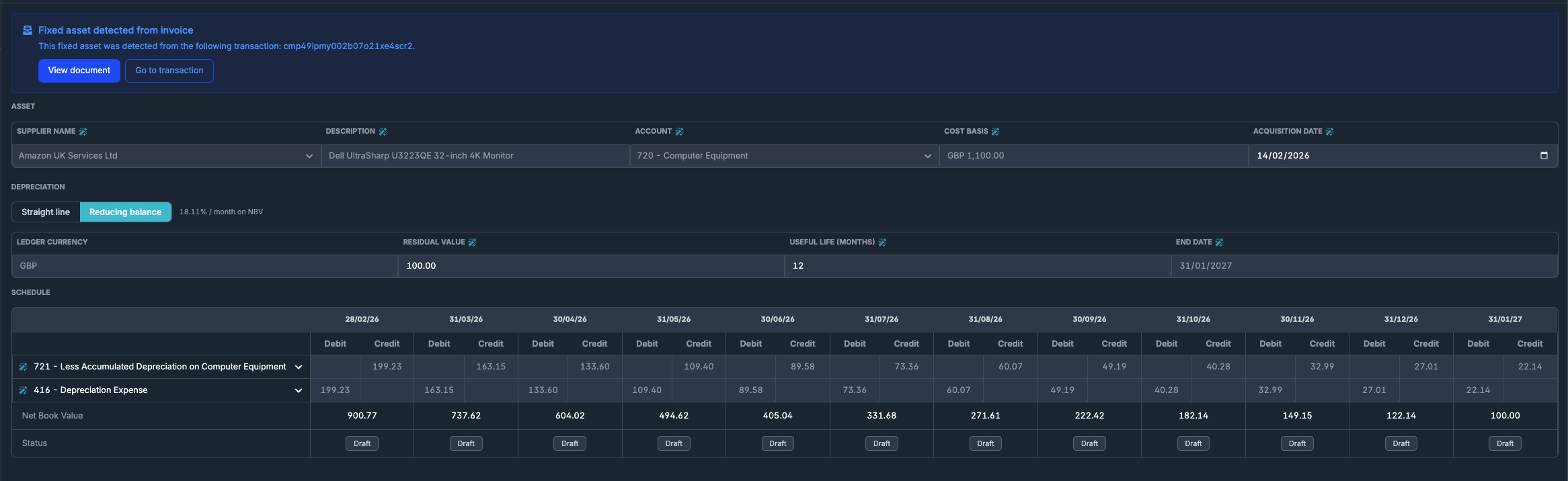
Briefcase now supports reducing balance depreciation alongside the existing straight-line method. You can toggle it on per schedule in the Fixed Assets UI.
Reducing balance suits assets that lose value faster in their earlier years - vehicles, machinery, and certain technology equipment are common examples.
With reducing balance:
- Depreciation is calculated on the asset’s remaining book value rather than its original cost, producing larger expenses early in the asset’s life that taper off over time.
- Schedules are still driven by the useful life and residual value you provide, so setup is consistent with the straight-line flow.
- Briefcase previews the effective depreciation rate implied by your useful life and residual value before you save the schedule.
For assets with a residual value of zero, Briefcase switches from reducing balance to straight-line for the remaining periods once that produces a higher depreciation amount. This is the standard industry approach and ensures the asset is fully depreciated by the end of its useful life.
VAT rate prediction for bank feed in BriefcaseOne
For VAT-registered users, Briefcase now automatically predicts and codes the tax rate for transactions in BriefcaseOne bank accounts.
Predictions are based on bank transaction details and continuously refined by how you code transactions yourself. This learning matters because bank descriptions are often vague or inconsistent - the more you code, the more accurate predictions become.
When there isn’t enough signal to make a confident call, we return no prediction rather than guessing.

How does this impact AutoPilot?
Tax rate predictions feed into both data completeness and historical consistency checks:
- If we can’t confidently predict a tax rate, data completeness fails and the transaction won’t be auto-created.
- If there’s insufficient historical consistency in the predicted tax rate, the transaction won’t be auto-created - the same way invoice consistency works today.
